
Renal Angioplasty And Stenting
-
Center for Coronary Artery Disease
Leading-edge therapies and diagnostics to manage or prevent coronary artery disease—before it leads to a heart attack or other complications.
-
Center for Vascular Disease
Multidisciplinary care for conditions that impact your blood vessels—from peripheral artery disease to aneurysms—using both surgical and catheter-based techniques.
Renal Angioplasty and Stenting
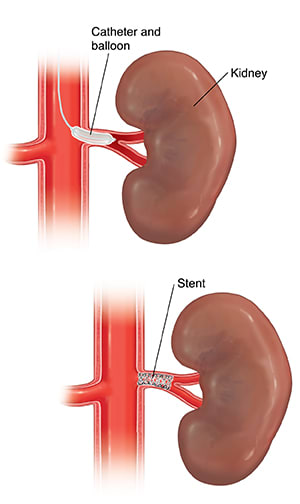
Renal angioplasty is a procedure that uses a small balloon to widen the passage through your renal artery. This is the main blood vessel that supplies your kidneys. A stent is a small metal mesh tube put into a blood vessel to help hold it open and improve the blood flow.
If your renal artery is narrowed or blocked, it can cause severely high blood pressure or problems with how your kidneys work. Renal angioplasty and stenting can help make blood flow to your kidney better and ease problems. The procedure is often done by a specially trained doctor called an interventional radiologist. This is a doctor who is trained and certified by the American Board of Radiology to use minimally invasive image-guided procedures to diagnose and treat diseases.
Before your procedure
Follow any directions you are given on how to get ready. This includes any directions you're given for not eating or drinking before the procedure.
Tell your doctor if you:
- Are allergic to X-ray dye (contrast medium) or other medicines.
- Are breastfeeding.
- Are pregnant or think you may be pregnant.
- Have any health conditions.
- Have had any recent illnesses.
Tell your doctor about all medicines you take. You may need to stop taking some or all of them before the test. This includes:
- All prescription medicines.
- Herbs, vitamins, and other supplements.
- Over-the-counter medicines, such as aspirin or ibuprofen.
- Marijuana or other drugs.
During your procedure
- You'll change into a hospital gown and lie on an X-ray table. An I.V. (intravenous) line is started in your arm or hand. This is to give you fluids and medicines. You may be given medicine through the I.V. to help you relax.
- Medicine will be put on the skin at the insertion site to numb it. The insertion site is often in the groin. Then a needle with a thin guide wire is put through the skin into the blood vessel. A thin, flexible tube called a catheter is placed over the guide wire into the blood vessel.
- X-ray dye is injected into the blood vessel. The radiologist uses X-ray images (fluoroscopy) as a guide. Then the catheter is moved through the blood vessels to your kidney.
- When the special catheter (angioplasty catheter) crosses the narrowed or blocked area, the radiologist inflates a special balloon attached to the catheter. This widens the artery (angioplasty). This part of the procedure may be done more than once with balloons of different sizes.
- A stent may be put in to hold the blood vessel open. To do this, a catheter with a stent on it is threaded over the guide wire. The stent is opened when it reaches the narrowed area. The stent stays in the artery. The catheters and balloons are taken out.
- When the procedure is done, pressure is put on the insertion site for 15 minutes to stop bleeding.
After your procedure
- You may be told to lie flat and keep the leg with the insertion site straight for 6 hours to stop bleeding.
- You may stay in the hospital overnight. If you don't stay in the hospital, you should plan to have someone drive you home.
- Drink plenty of fluids to help flush the X-ray dye out of your body.
- After you go home, care for the insertion site as directed.
- If you have a stent, you may need to take aspirin or a blood-thinning medicine (anticoagulant) after the procedure. This will help prevent blood clots. Talk with your doctor about this.
Possible risks
Possible risks from this procedure include:
- Bruising at the insertion site.
- Bleeding inside your body or around the insertion site.
- Damage to the artery. This includes the blockage getting worse and possible kidney damage. This may result in kidney failure and needs long-term dialysis.
- Infection.
- Problems because of the X-ray dye, including allergic reaction or kidney damage.

Why Choose Baptist Health?
At Baptist Health, patients benefit from state-of-the-art diagnostic imaging and advanced treatment options, delivered by a multidisciplinary team of surgeons and interventionalists who are pioneering cutting-edge techniques. Our team not only provides exceptional clinical care but also actively contributes to research and innovation in the field.
News & Podcasts
Roundup: Energy Drinks, Pre-workout Supplements Linked to Higher Risk of Heart Problems; and More News
November 13, 2026New Recommendations Urge ‘Exercise Prescriptions’ Across All Levels of Heart Health
November 9, 2026Gloria Drummond Patient Tower Opens at Boca Raton Regional Hospital
November 9, 2026Are Your Veins Cosmetic — or a Sign of Vascular Disease?
November 2, 2026Vascular Disease Can Start Young: Know the Risks and Symptoms
September 28, 2026Heart Disease in Women: Signs, Risks and Prevention
September 21, 2026Have Questions? Let's Talk.
Donate Today

Language Preference / Preferencia de idioma
I want to see the site in English
Continue In EnglishQuiero ver el sitio en Español
Continuar en español