
Breast Cancer Care is Evolving Rapidly. Here's What it Means for You
5 min. read
Baptist Health Herbert Wertheim Cancer Institute
Breast cancer treatment is becoming increasingly personal.
Instead of relying primarily on where a tumor is located, how large it is or whether it has spread to lymph nodes, physicians are gaining more sophisticated ways to understand the biology driving an individual cancer—and to use that information to select treatment, detect resistance and, in some cases, safely give patients less therapy.
For Breast Cancer Awareness Month, two specialists with Baptist Health Herbert Wertheim Cancer Institute highlight some of the most significant breast cancer research developments of 2026 and what patients may begin hearing more about in 2027.
“The most important shift is toward precision treatment, using tumor biology and response to therapy to determine not only what treatment a patient needs, but also what treatment she may safely avoid,” says Mehran Habibi, M.D., surgical breast oncologist, chief of breast surgery at Wertheim Cancer Institute and deputy chief of breast surgery for Baptist Health Cancer Care.
Targeted Treatments Move Earlier
Among the biggest advances is the continued evolution of antibody-drug conjugates, or ADCs—medicines designed to deliver cancer-killing drugs more directly to cancer cells.
“Antibody drug conjugates act like targeted delivery systems, using an antibody to recognize a protein on the cancer cell and deliver a potent chemotherapy payload more directly to the tumor,” explains Reshma Mahtani, D.O., medical oncologist at Wertheim Cancer Institute and chief of breast medical oncology at Baptist Health Wellness and Medical Complex.
In 2026, Dr. Mahtani says, these therapies continued moving into earlier stages and earlier lines of treatment, including for triple-negative and HER2-positive breast cancers. Some are also benefiting a broader range of patients than originally anticipated.
Dr. Habibi says that expansion makes accurately defining a tumor’s biological characteristics increasingly important from the start.
“‘Breast cancer’ is not one disease; even tumors that appear identical under the microscope can behave very differently at the molecular level,” he says. “Genomic and molecular profiling allows us to understand the biology driving an individual cancer.”
Finding Resistance Before a Scan Does
Another rapidly developing area involves circulating tumor DNA, or ctDNA—tiny fragments of DNA released by cancer cells into the bloodstream.
Blood-based testing is beginning to provide physicians with a more dynamic picture of how a cancer changes during treatment. In metastatic breast cancer, for example, doctors can sometimes detect mutations associated with resistance before conventional imaging shows progression.
One closely watched 2026 study, SERENA-6, demonstrated that physicians could detect an emerging ESR1 mutation in the blood and switch endocrine therapy before progression appeared on imaging, delaying disease progression.
“Blood-based ctDNA testing is beginning to give us a more dynamic picture of how a breast cancer is changing over time,” Dr. Mahtani says.
The technology may eventually have implications for early-stage disease as well. Dr. Habibi notes that highly sensitive ctDNA tests can sometimes identify molecular evidence of recurrence months—and potentially years—before cancer becomes clinically apparent.
The unanswered question is what physicians should do with that information.
“If we can identify molecular recurrence that early, the critical question now is whether intervening at that stage can prevent or delay metastatic disease,” he says.
When Less Treatment May Be Better
Some of the year’s most important research is focused not on adding treatment, but on determining when patients can safely receive less.
Dr. Habibi points to studies showing that selected patients may be able to avoid regional lymph-node radiation after responding to preoperative chemotherapy, while some women with small, clinically node-negative tumors may not need sentinel lymph-node surgery.
“De-escalation does not mean undertreating cancer,” he says. “It means eliminating treatments that do not add meaningful benefit for a particular patient.”
Systemic therapy is following a similar trajectory. Dr. Mahtani highlights the OPTIMA study, which found that genomic testing could help identify some patients with clinically high-risk, node-positive, estrogen receptor-positive, HER2-negative early breast cancer who could safely avoid chemotherapy.
The goal, she says, is to maintain excellent cancer outcomes while reducing both short- and long-term treatment side effects.
Toward Truly Individualized Care
Taken together, these advances are changing what it means to personalize breast cancer treatment.
Two patients whose cancers have the same stage and traditional subtype may now receive different therapies based on HER2 expression, genetic mutations, PD-L1 status, genomic risk, response to treatment or evidence of resistance detected in the blood.
“We are already there in many respects,” Dr. Habibi says. “Two patients with the same tumor size and stage may appropriately receive very different systemic therapy, and increasingly different surgery and radiation.”
For patients, however, the rapid pace of innovation does not change one fundamental message during Breast Cancer Awareness Month: screening and early detection remain essential.
“We are making real progress against breast cancer,” Dr. Mahtani says. “Early detection still matters enormously because finding a cancer at an earlier stage can significantly improve the chance of cure.”
And increasingly, the next step after diagnosis will not simply be deciding how much treatment a patient needs but determining precisely which treatment—and only the treatment—her particular cancer requires.
Visit BaptistHealth.net/Mammo to learn more or schedule your mammogram. Eligible women can now schedule a screening mammogram without a provider’s order.
Featured Providers

Reshma Lillaney Mahtani, DO
Reshma Mahtani, D.O., is a medical oncologist at Baptist Health Herbert Wertheim Cancer Institute and chief of breast medical oncology at Baptist Health Wellness and Medical Complex. She specializes in the treatment of breast cancer.
Prior to joining Baptist Health Cancer Care in 2022, Dr. Mahtani worked as an associate professor of medicine and co-leader of the Breast Cancer Site Disease Group at the Sylvester Comprehensive Cancer Center, University of Miami Miller School of Medicine. She also served as the director of community outreach.
Dr. Mahtani earned her medical degree at the University of New England College of Osteopathic Medicine in Portland, Maine. She completed an internal medicine internship at Greenwich Hospital, a Yale affiliate, in Greenwich, Conn. She also completed an internal medicine residency and a hematology-oncology fellowship at St. Vincent’s Catholic Medical Center in New York.
Dr. Mahtani is an active clinical researcher, helping bring novel breast cancer treatments and clinical trials to patients in South Florida. She has made significant scientific and clinical practice contributions and has received funding from numerous organizations. As a nationally recognized thought leader in breast cancer, she has numerous first-author publications in peer-reviewed journals and has presented her cancer research findings at cancer conferences worldwide. She serves as editor-in-chief for Practice Update, an online medical education platform for physicians, and has served on national committees to recognize cancer clinics that offer quality care across the country.
Known for her passion for medical education, she founded an education initiative to ensure that physicians in South Florida know about the latest cancer treatments and can provide evidence-based care. She is also involved in several initiatives that enhance patients’ access to healthcare, as well as community collaborations for education and advocacy.
Though she is a passionate researcher, Dr. Mahtani most enjoys spending time with her patients. She believes it is a privilege to be by their side, teaching them about their breast cancer and treatment options. She strives to help every patient find hope through clinical trials and the latest novel treatments for breast cancer.
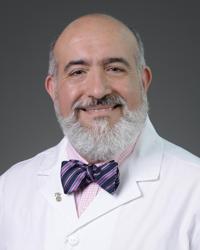
Mehran Habibi, MD
Mehran Habibi, M.D., MBA, is an internationally recognized surgical breast oncologist with over two decades of clinical and academic leadership. He serves as chief of breast surgery at Baptist Health Herbert Wertheim Cancer Institute and deputy chief of breast surgery for Baptist Health Cancer Care. His clinical expertise includes oncoplastic and nipple-sparing mastectomies, nerve-preserving and risk-reducing procedures, and advanced intraoperative tumor localization and margin assessment technologies.
Before joining Baptist Health, Dr. Habibi held senior leadership roles at Northwell Health, including director of breast surgery at Staten Island University Hospital, regional chief of breast surgery for Northwell’s Western Region and director of international program development for Northwell Cancer Institute. He also served as an associate professor of surgery at the Donald and Barbara Zucker School of Medicine at Hofstra/Northwell. Prior to that, he spent more than 15 years at Johns Hopkins University School of Medicine, where he founded and led the Breast Center at the Bayview Medical Center.
Dr. Habibi’s research program spans surgical innovation, genomics and tumor microenvironment studies. His current investigations include wire-free localization techniques, intraoperative margin assessment tools and studies of tumor tissue mechanics, breast cancer genomics, and the role of the microbiome in breast cancer progression and therapy response. His research has been supported by multiple grants and published in high-impact peer-reviewed journals.
Certified by the American Board of Surgery, Dr. Habibi is a fellow of the American Society of Breast Surgeons and a reviewer for The Breast Journal and JAMA Surgery. He is also an editorial board member of Archives of Breast Cancer.
Dr. Habibi earned his medical degree at Islamic Azad University in Tehran and completed surgical training at Pennsylvania Hospital and St. Luke’s Hospital. He completed a fellowship in complex surgical oncology at the Medical College of Virginia and holds a master’s degree in business administration from Virginia Commonwealth University.
Outside the operating room, Dr. Habibi is known for his love of photography, swimming and baking—where his pastry skills rival his surgical precision.

Leading the Way in Cancer Care and Research
Related Stories
View All Articles
Major Updates to Prostate Cancer Screening: What Men Need to Know About New Guidelines
November 16, 2026
9 min. read

Lung Cancer Care Is Changing: Why Early Detection and Personalized Treatment Matter
November 12, 2026
4 min. read

Understanding Lung Cancer: It's Not Just One Disease but Many
October 14, 2026
6 min. read